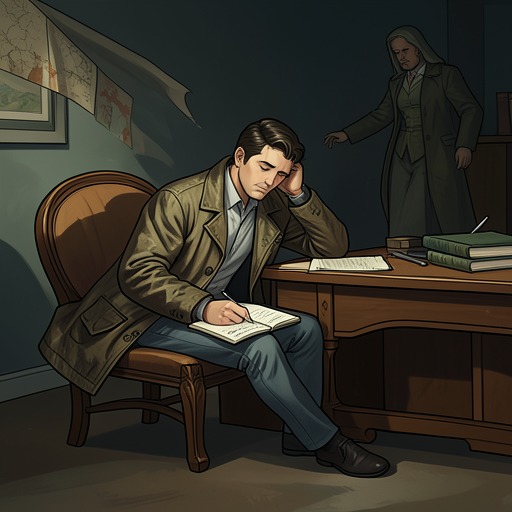
James Murray and William Chester Minor
The Surgeon of CrowthorneJames Murray and William Chester Minor were joined by nearly two decades of correspondence, sustained work on the Oxford English Dictionary, and a friendship that began only after Murray discovered that his valued contributor lived inside Broadmoor Asylum. Their relationship matters not only as a partnership in scholarship but as a history repeatedly reshaped by legend: the famous meeting often placed in 1896 was a journalistic invention, while the documented encounter occurred in January 1891. The distinction reveals a bond formed through words before the men knew one another face to face.
A correspondence before acquaintance
Murray and Minor exchanged letters about the finer points of English lexicography for years before meeting. Minor became one of the most prolific among the Dictionary’s thousands of volunteer contributors, while Murray, its editor, relied on readers who searched texts and supplied evidence for words and usages. The work connected two very different lives: Murray’s sustained editorial labor in Oxford and Minor’s scholarly activity from his home at Crowthorne, which was in fact Broadmoor Asylum.
At first, Murray did not understand the significance of that address. He thought Minor might be a retired medical man with ample time for reading. When he realized that Broadmoor was a large asylum, he initially supposed Minor could be its medical officer. The gap between what Murray knew and what the address meant makes the correspondence’s early years especially striking: Minor’s learning was visible in his contributions, while the circumstances shaping his life remained largely hidden from his correspondent.
Murray nevertheless wanted to meet and thank him. As the Dictionary approached the halfway point, its creators were receiving public honours, and Murray was concerned that contributors such as Minor should be recognized for their work. His wish to make the acquaintance of a particularly assiduous reader was therefore both personal and bound to the collaborative project: the Dictionary depended on labor supplied by people beyond its editorial rooms.
The meeting behind the legend
A popular version placed Murray’s visit in Crowthorne in the autumn of 1896. In that telling, he travelled from Oxford expecting to meet a private, well-to-do scholar, only to discover that Minor was an inmate and that the mansion he had imagined was an asylum. The dramatic reversal made the encounter memorable, but the book identifies this account as fiction created by the American journalist Hayden Church. Church published it in the Strand in 1915, after first trying a version in a Washington newspaper; its sensational framing helped the story spread.
Murray’s own account, in a 1902 letter to Francis Brown in Boston, gives a different chronology. Murray said his first contact with Minor probably came in 1880 or 1881, soon after he began work on the Dictionary. The relationship was already established through frequent letters before Murray learned what Minor’s address signified. This distinction matters: the encounter was not a single astonishing discovery that created their connection, but a face-to-face meeting within an existing scholarly relationship.
The actual meeting took place in January 1891, six years before the date favored by the romanticized version. Murray had written to Dr Nicholson for permission to visit. His arrangements depended on a train from Reading, and he admitted in his letter that he relied on his wife to manage such travel details. The visit began over lunch and initiated a long, firm friendship. In the account of their relationship, the bond rested on wary mutual respect and, above all, a shared love of words.
Scholarship, friendship, and unequal circumstances
The two men’s common work did not erase the difference between their positions. Murray was becoming the Oxford English Dictionary’s leading editor, a role he held for the last forty years of his life. Minor, an American former army surgeon, contributed from within Broadmoor Asylum, where he had been confined after serious mental illness and a killing. Their relationship thus joined an editor working at the center of a major publishing project to a contributor whose life was restricted by institutional confinement.
The record also preserves a moral consequence of Minor’s crime that shaped the circumstances around him: Murray learned that Minor gave a large part of his income to support the widow of the man whose death he had caused, and that she regularly visited him. Dr Nicholson held Minor in high regard and allowed distinguished visitors to see him and his books. These details help explain how Murray could encounter not only an exceptionally productive reader but a person whose scholarly life and personal circumstances could not be separated from the institution where he lived.
The Dictionary as a shared point of purpose
Minor’s contributions made him a significant participant in the Dictionary, while Murray’s editorial work gave those contributions a place in a collective record of English usage. The partnership depended on exchange: Minor supplied reading and evidence; Murray received, assessed, and incorporated the work into a project far larger than either contributor alone. Their sustained correspondence made the relationship more than a sequence of submitted materials, and their visits developed it into a friendship.
The Dictionary also offered Minor a durable intellectual routine. The book’s account describes his work on quotation slips as a fixed focus that appeared to provide some release from his paranoia; when the Dictionary ceased to serve as that lodestone, his condition worsened. This does not make Murray a physician or their collaboration a treatment plan. It does show why the work carried a meaning beyond scholarly productivity for Minor: the correspondence connected his confined life to an ongoing undertaking, and the shared subject of words gave the friendship its distinctive ground.
The corrected story and its significance
The false 1896 encounter endured because it compressed the relationship into a single scene of revelation: the celebrated editor arrives expecting a fellow scholar and discovers an asylum inmate. The documented history is less theatrical but more substantial. Murray and Minor had already corresponded for years; Murray sought permission to visit, and their first meeting in 1891 began a friendship that continued alongside their Dictionary work for nearly twenty years.
Correcting the legend does not diminish the relationship. It shifts its meaning from a sensational surprise to an extended collaboration sustained across unequal circumstances, in which intellectual recognition preceded full personal knowledge. Their story also shows how a volunteer enterprise could draw in a contributor whose circumstances its editor initially misunderstood, and how shared scholarly labor could become the basis for mutual regard. The enduring connection was not the dramatic discovery invented for the newspapers, but the repeated work, correspondence, and visits that joined Murray and Minor over time.